IoT Research Group Β· IT4010 Β· 2025 July

Smart Agriculture Assistant: AI-Powered System for Crop Health & Soil Monitoring

An integrated AI and IoT-based platform that automates crop health diagnostics and soil condition monitoring, empowering small- and medium-scale Sri Lankan farmers with real-time, data-driven insights.

πŸ€– Machine Learning πŸ“‘ IoT Sensors 🌿 Sri Lankan Agriculture πŸ“± Mobile & Edge AI

Research Domain

This section presents the research background, identified gap, core problem, objectives, and methodology behind the AI-based system developed for Sri Lankan medicinal plants.

Literature Survey

Modern agriculture has increasingly adopted Artificial Intelligence (AI), Internet of Things (IoT), machine learning, and cloud computing technologies to improve farming productivity and sustainability. Many previous studies highlight the use of IoT sensor networks to monitor soil moisture, pH levels, nutrient content, temperature, and humidity in real time. These systems help farmers optimize irrigation, fertilization, and field management practices. In parallel, computer vision techniques using Convolutional Neural Networks (CNNs) have been widely applied for automatic plant disease identification through leaf image analysis. Research has also introduced predictive analytics models for pest outbreaks, crop yield estimation, and climate-based decision support. Despite these advancements, many available solutions focus only on specific tasks and lack complete integration. Therefore, there is growing demand for smart agricultural platforms that combine multiple technologies into one efficient ecosystem.

Research Gap

Although several smart agriculture systems have been developed, many of them are limited in functionality, affordability, and accessibility. Existing solutions often concentrate only on disease detection, pest monitoring, irrigation control, or soil analysis individually rather than providing a complete farming support system. In addition, most advanced platforms require expensive hardware, strong internet connectivity, or technical expertise, making them unsuitable for small and medium-scale farmers. Another key limitation is the lack of localized AI models trained for regional crops, climate conditions, and farming practices. Few systems also provide multilingual interfaces, voice guidance, or explainable AI outputs that help farmers understand recommendations. Hence, there is a clear research gap for a cost-effective, user-friendly, localized, and integrated smart agriculture assistant.

Research Problem

Agriculture currently faces serious challenges due to climate change, unpredictable weather patterns, pest infestations, declining soil fertility, water scarcity, and increasing production costs. Traditional farming methods mainly rely on manual inspections and farmer experience, which can result in delayed disease identification, inefficient fertilizer use, poor pest control, and reduced crop yield. Farmers often lack access to timely information regarding soil health, plant growth conditions, and potential risks. This problem is more severe for small-scale farmers who cannot afford modern precision agriculture tools. Without intelligent support systems, farmers may experience crop losses, low profitability, and unsustainable farming practices. Therefore, there is a strong need for an affordable technology-driven solution that enables faster and smarter agricultural decision-making.

Research Objectives
  • To develop a localized AI system that identifies crop species and evaluates visible crop health conditions in Sri Lankan farming environments.
  • To detect and classify plant diseases, pest infestations, and abnormal growth patterns for early intervention.
  • To provide practical decision support for soil management, fertilizer selection, irrigation scheduling, and pest control.
  • To deploy the complete solution as a lightweight web platform that remains accessible and useful for both rural and urban farming communities.

The main objective of this research is to design and develop an AI-powered Smart Agriculture Assistant that supports farmers in improving productivity, reducing crop losses, and promoting sustainable farming practices. Specific objectives include developing an IoT-based soil monitoring system to measure pH, moisture, and nutrient levels in real time. Another objective is to implement AI-based crop disease detection using image processing techniques. The research also aims to create predictive models for pest outbreaks and abnormal crop growth patterns. Additionally, the system will provide real-time alerts, treatment recommendations, and decision support through a mobile or web application. A further objective is to ensure the solution remains affordable, scalable, and practical for local farming communities.

Methodology

The research follows a system development methodology that integrates hardware, software, and artificial intelligence components. Initially, soil sensors will be deployed in agricultural fields to collect parameters such as moisture, pH, and nutrient levels. Simultaneously, crop images will be captured using cameras or smartphones for disease and growth analysis. Collected data will be transmitted to a cloud platform where machine learning and deep learning models process the information. CNN models will classify plant diseases, while predictive algorithms analyze pest risks and crop growth abnormalities. The processed outputs will then be displayed through a user-friendly dashboard or mobile application with alerts, charts, and recommendations. Finally, field testing, farmer feedback, and performance evaluation will be conducted to validate system accuracy, usability, and real-world effectiveness.

System Overview
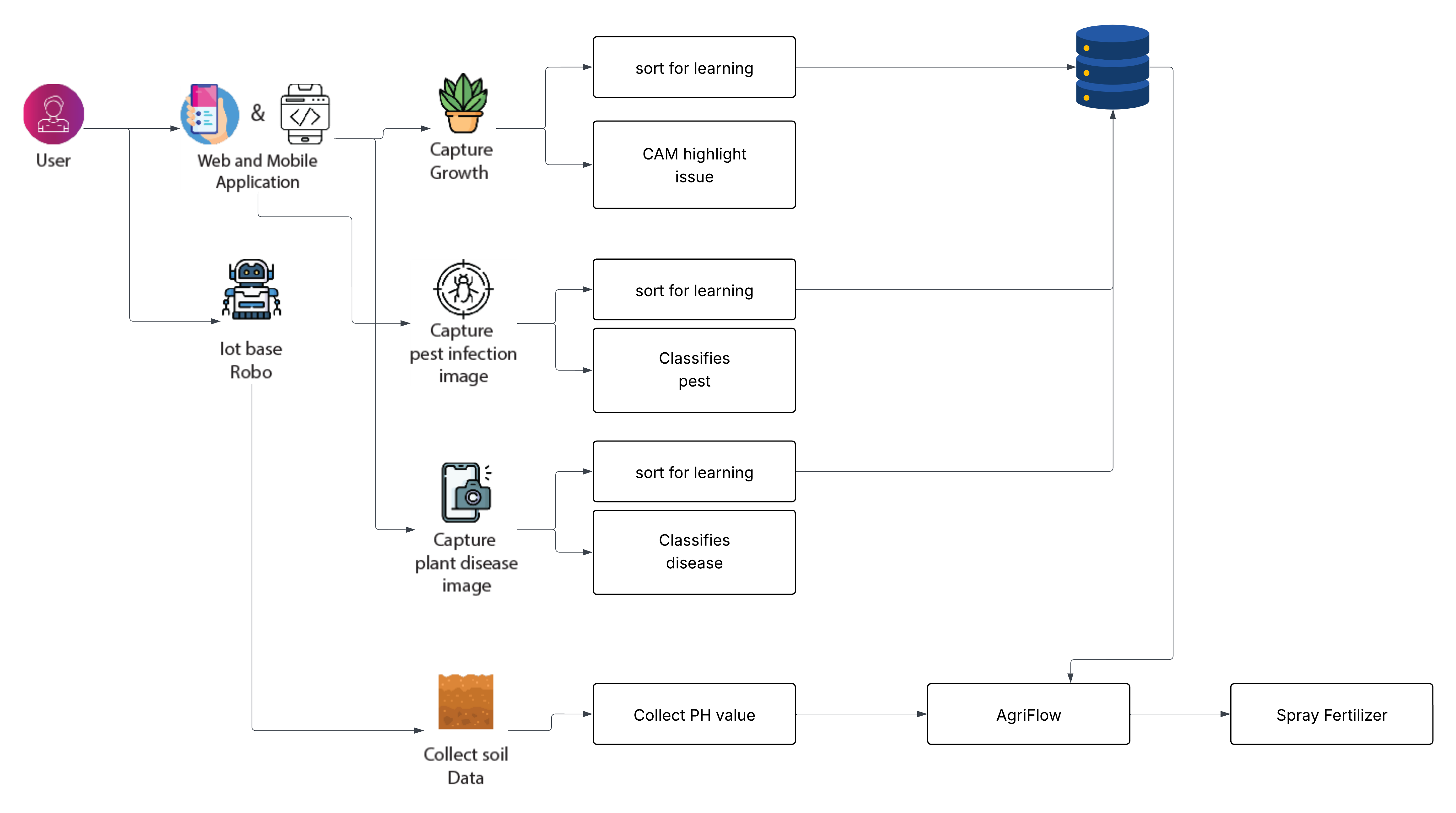
System Overview

Workflow of Components
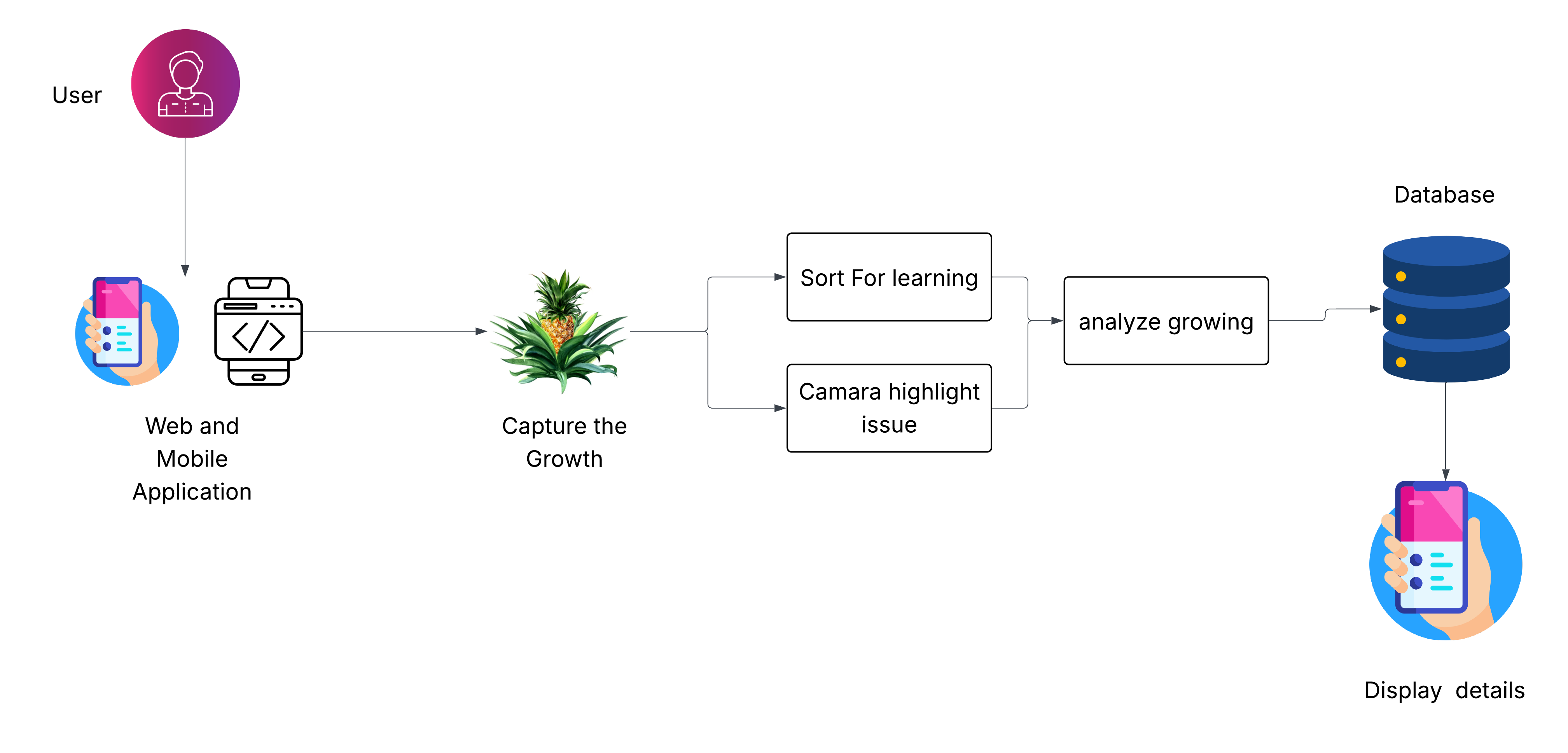
Flowchart 1

Four Core Modules

Each team member owns a dedicated module, contributing unique AI capabilities to the integrated platform.

1

IoT Soil Monitoring

Mobile robotic arm with calibrated pH, moisture, and nutrient sensors. Wireless IoT transmission with instant voice output for hands-free farmer feedback.

2

AI Plant Disease Detection

CNN-based model trained on localized Sri Lankan crop disease images. Offline-capable on mobile devices with voice-based diagnosis for low-literacy users.

3

Pest Outbreak Prediction

Predictive AI fuses image analysis with environmental inputs. Real-time spoken risk alerts warn farmers of mealybug or pest outbreaks before damage occurs.

4

Stunted Growth Monitoring

Grad-CAM explainable CNNs analyze farmer-submitted photos. Crowdsourced network detects regional threats and delivers voice alerts in native Sinhala/Tamil.

Technologies Used

Combining machine learning, IoT, cloud computing, and mobile development for a complete agri-tech platform.

ReactJs ReactJs
Python Python
NodeJs NodeJs
Express Express
FastAPI FastAPI
MongoDB MongoDB
Google Colab Google Colab
Pandas Pandas
OpenCV OpenCV
TensorFlow TensorFlow
Scikit-learn Scikit-learn
Roboflow Roboflow
VS Code VS Code
Postman Postman
GitHub GitHub
ReactJs ReactJs
Python Python
NodeJs NodeJs
Express Express
FastAPI FastAPI
MongoDB MongoDB
Google Colab Google Colab
Pandas Pandas
OpenCV OpenCV
TensorFlow TensorFlow
Scikit-learn Scikit-learn
Roboflow Roboflow
VS Code VS Code
Postman Postman
GitHub GitHub

Research Objectives

Main Objective: Design and deploy an integrated AI and IoT-based Smart Agriculture Assistant that automates crop health monitoring and soil quality assessment, providing real-time decision support to farmers for improved productivity and sustainable farming.

M.A.C.S Marasingha Β· IT22254870

IoT-Based Soil Monitoring Module

Design and fabricate a robotic arm, integrate and calibrate soil pH, moisture, and nutrient sensors, develop IoT transmission with voice output, deploy and validate in test fields.

πŸ€– Mobile robotic arm for multi-point soil analysis
Perera W.A.N.D Β· IT22072160

AI-Powered Disease Detection

Collect image datasets, train and test machine learning models, deploy detection via mobile or edge device, and enable spoken diagnosis for hands-free farmer use.

πŸ“± Offline AI on mobile Β· spoken output
Rathninda H.M.K.B.P.B Β· IT22275592

AI-Powered Pest Infection Detection

Conduct real field trials with local farmers, gather pest data, train predictive AI models that fuse images and environmental inputs, deploy real-time spoken risk alerts.

⚠️ Predicts outbreaks before damage occurs
Thilakarathna VN Β· IT22336354

AI-Powered Stunted Growth Monitoring

Analyze farmer-submitted crop photos using explainable CNNs with Grad-CAM heatmaps to detect nutrient deficiencies and growth issues. Crowdsourced regional threat detection.

πŸ—ΊοΈ Grad-CAM explainability Β· no costly hardware

Project Milestones

Key checkpoints in our research journey from registration to final thesis submission.

Group Registration 16 May 2025 β–Ό

Initial formation of the research group and registration for the IT4010 Research Project module.

Find Research Topic & Supervisor 26 May 2025 β–Ό

Selection of project supervisor Dr. Kapila Dissanayaka and finalization of the Smart Agriculture Assistant topic through initial research discussions.

Topic Assessment Form 17 Jun 2025 β–Ό

Evaluation and approval of the selected research topic. Supervisor evaluated the scope, novelty, and feasibility β€” all criteria marked Yes.

βœ… Completed
Charter Submission 23 Jul 2025 β–Ό

Project charter submission including scope, objectives, timeline, and team responsibilities.

βœ… Completed
Project Proposal Report Submission 15 Aug 2025 β–Ό

Formal written proposal presenting research objectives, methodology, and expected outcomes.

βœ… Completed
Project Proposal Presentation 9 Sep 2025 β–Ό

Oral presentation of research objectives, methodology, and expected outcomes to the panel.

βœ… Completed
Progress Presentation 1 5 Jan 2026 β–Ό

First evaluation of project progress including research and initial implementation.

Marks: 15% βœ… Completed
Checklist I 11 Jan 2026 β–Ό

First phase checklist confirming early development activities.

βœ… Completed
Progress Presentation 2 10 Mar 2026 β–Ό

Second progress evaluation focusing on system implementation and module integration.

βœ… Completed
Draft Final Report & Website Submission 26 Apr 2026 β–Ό

Submission of the draft final research report and project website for evaluation.

πŸ”„ In Progress
Website Evaluation & Log Book 27 Apr 2026 β–Ό

Website evaluation and submission of project log book documenting weekly progress and team contributions.

Final Presentation & Viva 28 Apr 2026 β–Ό

Final oral defense presenting the complete system to the panel.

Research Paper Submission 8 May 2026 β–Ό

Submission of the academic research paper for publication consideration.

Final Thesis Submission 13 May 2026 β–Ό

Complete final thesis and research paper publication evidence submission.

Documents

Access all project documents including proposals, checklists, research paper, and final reports.

πŸ“‹
PDF Completed

Topic Assessment Form

Initial evaluation of the selected research topic covering relevance, feasibility, innovation, and academic value before project development began. Project ID: 25-26J-389.

View Document β†—
πŸ“‘
PDF Completed

Project Proposal Document

Full research proposal presenting the problem background, objectives, methodology, system overview, and expected outcomes of the Smart Agriculture Assistant.

View Document β†—
βœ…
Text Completed

Checklist Documents

Combined checklist documents covering project requirements, progress tracking, completed tasks, evaluation criteria, and submission readiness across multiple project phases.

View Documents β†—
πŸ“–
PDF Completed

Research Paper

Academic research findings including literature review, methodology, AI model analysis, implementation insights, results, and conclusions for publication.

View Document β†—
πŸ“—
PDF In Review

Final Report

Complete documentation of the project including full system design, implementation details, testing outcomes, and the overall final submission content.

View Document β†—
πŸ““
PDF In Review

Log Book Report

Development journey record including weekly progress, team activities, task updates, and important milestones achieved throughout the research period.

View Document β†—

Project Slides

Access all project presentation decks from proposal through to final defense.

Proposal Presentation

OverviewArchitectureObjectives

Introduction to the project covering research background, problem statement, main objectives, proposed system architecture, and overview of all four AI modules.

View Slides β†—

Progress Presentation 1

50% CompleteProgressRoadmap

Demonstration of progress to the 50% milestone including initial implementation results, completed module features, and the development roadmap for remaining work.

View Slides β†—

Progress Presentation 2

ModulesIntegrationImplementation

Covers completion of all major AI components, module integration, and technical progress achieved. Presents a near-complete version of the full system with detailed workflows.

View Slides β†—

Final Presentation

Full SystemResultsFuture Work

Complete explanation of the entire Smart Agriculture Assistant system, final results, challenges encountered during development, and potential future enhancements.

View Slides β†—
Our Research Team

About Us

Meet the dedicated team behind AgriSense, committed to combining artificial intelligence with Sri Lankan agriculture.

Sri Lanka Institute of Information Technology Malabe, Sri Lanka

M.A.C.S Marasingha

M.A.C.S Marasingha

Dept. of Information Technology

Research Team Member

it22254870@my.sliit.lk

LinkedIn β†—
Perera W.A.N.D

Perera W.A.N.D

Dept. of Information Technology

Research Team Member

it22072160@my.sliit.lk

LinkedIn β†—
Rathninda H.M.K.B.P.B

Rathninda H.M.K.B.P.B

Dept. of Information Technology

Research Team Member

it22275592@my.sliit.lk

LinkedIn β†—
Thilakarathna VN

Thilakarathna VN

Dept. of Information Technology

Research Team Member

it22336354@my.sliit.lk

LinkedIn β†—

See AgriSense in Action

A visual walkthrough of our research journey β€” field data collection, AI model development, and the final system demo.

Smart Agriculture Assistant β€” Project Demo

This video presents our complete project journey: field data collection with the IoT robotic arm, AI model training sessions, mobile app testing on real crop images, and the final integrated system demonstration.

πŸ€– IoT Field Tests 🌿 AI Diagnosis Demo πŸ“Š Results Showcase
Watch Full Video β†—
β–Ά

Click to watch the project demo

Contact Us

Have questions about the research, collaboration opportunities, or the project? Reach out to our team.

Contact Information

πŸ“§
Email

agrisence.sliit@gmail.com

πŸ“ž
Phone

+94 77 9710 453

πŸ“
Address

Sri Lanka Institute of Information Technology

Send a Message